


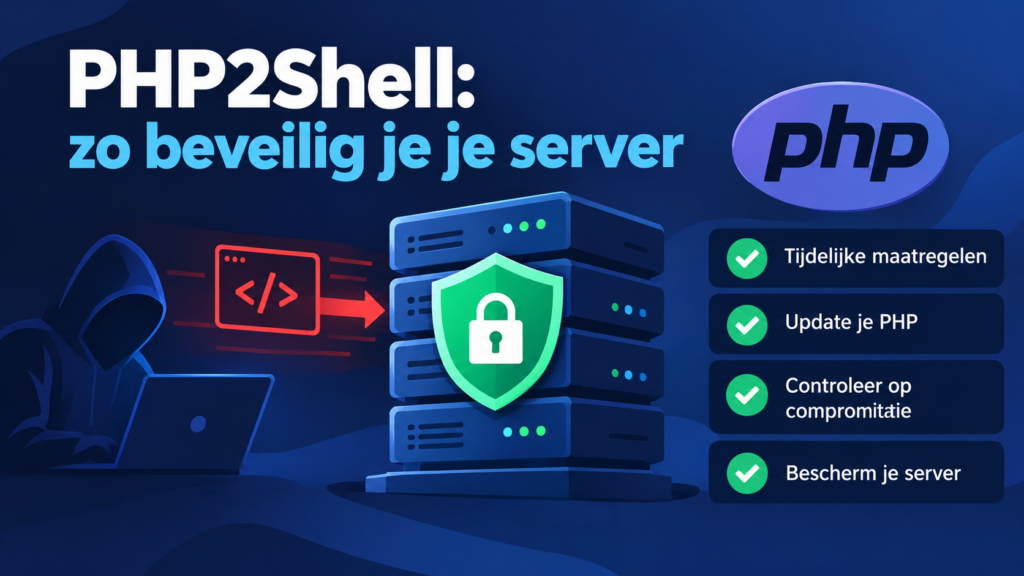
The patch for PHP2Shell has been released. As of Wednesday, October 21, 2026, at 4:00 PM Dutch time, PHP 8.5.12, 8.4.27, 8.3.36, and 8.2.35 are available. They address two critical vulnerabilities that allow an attacker to execute code on your server without logging in. The PHP team is clear: only updating makes you secure, and […]
Category Archives: Linux
21
Oct
Oct
Do you want to update your Linux Server? Then click on the blog article below: “If you run websites or applications on PHP, update today. On Wednesday, October 21, 2026, at 4:00 PM Dutch time (14:00 UTC), the PHP team will release an emergency update for two critical vulnerabilities known as PHP2Shell. The details were […]
First, there are many Slowloris now you can use… But i really would prefer you to use the orginal one in perl if you’re running Linux. No clone seems so mighty like the original! Lets how to install Slowloris Get a Copy if Slowlors http://ha.ckers.org/slowloris/ sudo apt-get install perl (normally you got perl already) sudo […]
HTTP Protocol Basics HTTP is a plaintext protocol. Thereby, simulating a browser and testing access through port 80 using the telnet command becomes simple. The following steps are necessary for this from a Linux command line: Execute telnet SERVERNAME 80. Thereby, telnet will connect to the server named SERVERNAME through port 80. If the establishment […]
Hard disk space is the amount of storage space expressed in GigaBytes (GB) as included in your VPS package. This determines the amount of data that can be stored on your VPS. You can expand the disk space of your BladeVPS by ordering an Add-on through the Control Panel. You can add up to 400GB […]
Goal of a Secure Erase According to the ATA specification, a secure erase should guarantee the secure erasure of all stored data on a storage medium. Most SSDs support secure erase, executing it for the physical deletion of all blocks on the SSD. The SSD will then be usable at its original ideal performance level, […]
1. Add an IPv6 address to your web server The first step is to get your web server listening on an IPv6 address, as well as an IPv4 address. How you achieve this will depend on how your web server is managed. If you’re on a shared hosting account, you’ll be dependent on your hosting […]
Hard disk allocation under Linux can be reviewed using the following commands. df disk free displays the free (meaning available) storage space on the hard disk. Display free storage space for the entire file system df -h Display free storage space for the local file system df -hl du disk usage displays the storage space […]
MySQL is a popular database management system used for web and server applications. This guide will introduce how to install, configure and manage MySQL on a Linode running Debian 7 (Wheezy). This guide is written for a non-root user. Commands that require elevated privileges are prefixed with sudo. Before You Begin Ensure that you have […]
The Core of a CPU is where it is all about. The core is the center of your VPS. It makes all calculations. The number of CPU Cores specifies the number of server processors from which your VPS can make use of and decides the speed at which your VPS can handle the instructions of […]